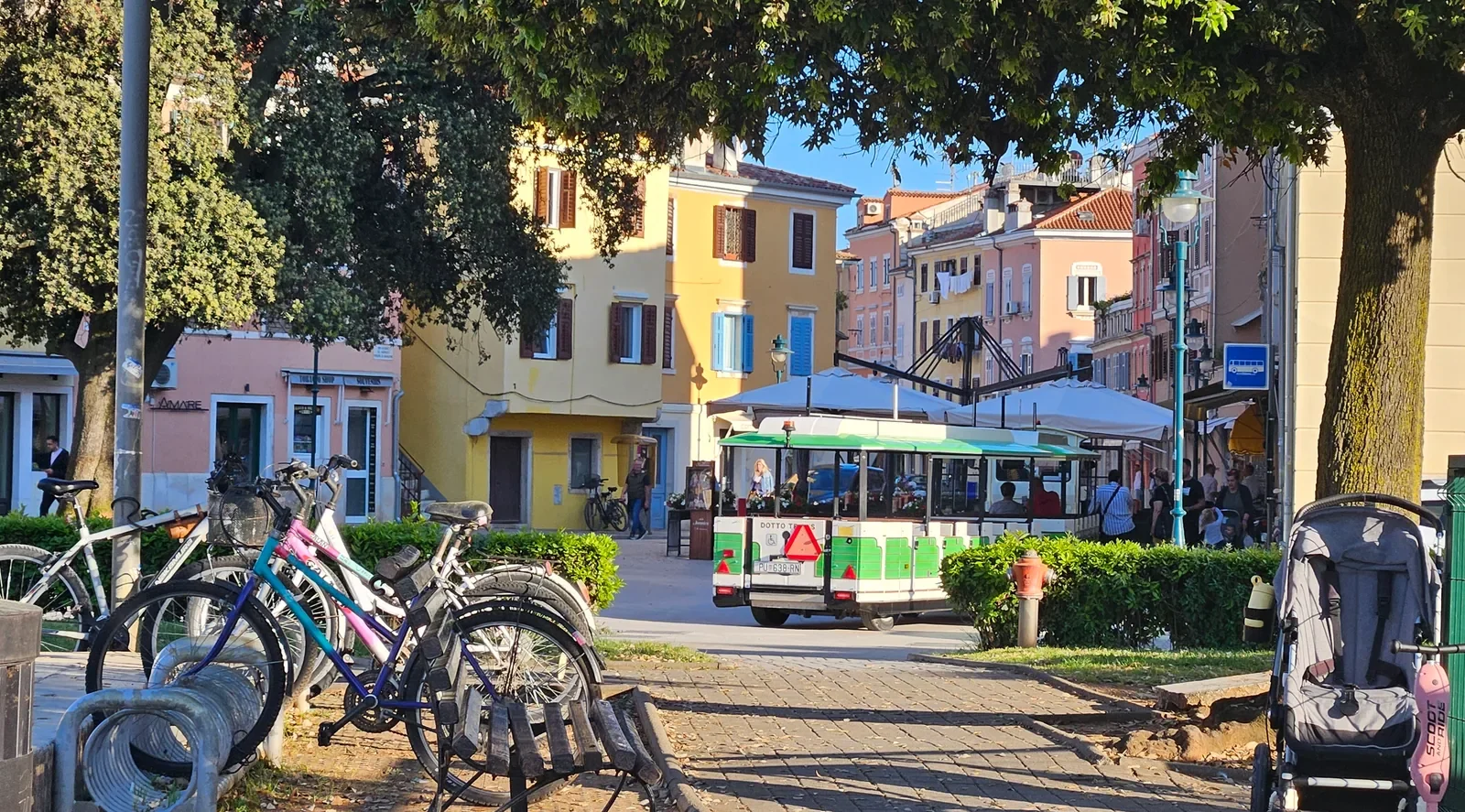
Rovinj is compact enough that most visitors spend much of their stay walking, but public transport becomes useful when your accommodation is outside the centre, when you want to reach campsites and resorts on the edge of town, or when you are planning an intercity bus trip. The key point is that Rovinj has two different bus systems visitors often confuse: seasonal local municipal lines around Rovinj, and regional/intercity buses that leave from the main bus station.
The City of Rovinj currently lists four seasonal local bus lines operating between 1 June and 1 October. They connect the centre with Amarin and Borik to the north, Valalta, Polari and Villas Rubin to the south, and Veštar and Kokaleto further south-east. The city centre itself is highly walkable, and buses do not enter the pedestrian streets of the Old Town.
Quick answer: is public transport in Rovinj useful for tourists?
Yes, but mainly in summer and mainly for journeys between the centre and outlying accommodation areas. If you are staying in or near the Old Town, Carera, the harbour or the central waterfront, you will probably walk most of the time. If you are staying in Amarin, Borik, Valalta, Polari, Villas Rubin, Veštar or nearby holiday villages, seasonal local buses can save a long walk in hot weather.
For trips to Pula, Poreč, Vrsar, Pazin, Rijeka, Zagreb and other destinations, use the regional and intercity services from Rovinj Bus Station rather than the municipal local lines.
Rovinj Bus Station: location and what to expect
Rovinj Bus Station is at Trg na Lokvi 6, close to the southern side of the centre. Arriva describes it as less than 100 metres from the waterfront and within walking distance of the Old Town. In practical terms, this is a very convenient location: you can arrive by regional bus and walk to the harbour area in a few minutes, while the historic peninsula is still easily reachable on foot.
The bus station is small compared with those in Zagreb or Rijeka, so allow a little extra time in high season when several departures, taxis and luggage movements can make the area feel crowded. If you have an early departure, check the platform and ticket arrangements the day before rather than assuming the station will operate like a large terminal.
Current station details and intercity departures can be checked on Arriva Croatia’s Rovinj bus station page.
Seasonal local bus lines in Rovinj
The City of Rovinj’s official local transport page lists four municipal lines. The present concession period began in 2023 and runs for five years, so these are the core routes visitors should know about in 2026. Timetables can still change, especially around the start and end of the summer season, so always recheck the official page close to your travel date.
| Line | Main route | Useful for visitors staying in |
|---|---|---|
| 1 | Rovinj Bus Station – Valdibora – Porton Biondi – hospital – Borik – Hotel Amarin – Amarin Resort | Borik, Amarin and the northern coast |
| 2 | Valalta – Valsaline – Brajković area – waterfront turnaround | Valalta and accommodation north of town |
| 3 | Rovinj Bus Station – Centener – Villas Rubin – Polari | Centener, Villas Rubin and Polari |
| 4 | Rovinj Bus Station – shopping-centre area – Monfiorenzo – Kokaleto – Veštar | Kokaleto, Veštar and the south-eastern outskirts |
Line 1: Amarin, Borik and the northern side
Line 1 is one of the most useful routes for visitors because it links the central bus-station area with Valdibora, Porton Biondi, the hospital, Borik and Amarin. It is particularly helpful if you are staying at a resort north of the centre and want to avoid walking the full coastal distance each time you visit town.
Line 2: Valalta and Valsaline
Line 2 serves the Valalta and Valsaline area and approaches the waterfront from the north. This route is useful for visitors staying in the large holiday-camp zone beyond the normal walking radius of the Old Town.
Line 3: Centener, Villas Rubin and Polari
Line 3 runs south from the bus station via Centener to Villas Rubin and Polari. Centener itself is close enough to the centre for many people to walk, but the bus becomes more useful the farther south you are staying, especially with children, beach equipment or during the hottest part of the day.
Line 4: Kokaleto and Veštar
Line 4 links the bus station with the shopping-centre area, Monfiorenzo, Kokaleto and Veštar. This is useful for accommodation south-east of central Rovinj, where walking into town is less practical than from the central neighbourhoods.
When do local buses run?
The city states that local municipal transport is seasonal, running from 1 June to 1 October. Individual timetables may include extra departures during July and August. Outside that period, do not plan your stay around the summer municipal lines.
This seasonal pattern is important for spring, autumn and winter visitors. Rovinj is still easy to explore without a car if you stay centrally, but travellers in outlying resorts should confirm what their accommodation provides and consider taxis, transfers or a rental car when the municipal buses are not operating.
Tickets and fares
The City of Rovinj publishes fare sheets for each local line on its official transport page. Because fare documents and operator conditions can be updated separately from the general route information, it is better to check the official page shortly before travelling rather than relying on an old screenshot or an older travel blog.
For regional and intercity buses, fares depend on route, date and operator. Online booking is often the easiest option for popular summer departures, and it reduces the risk of turning up for a full bus on a busy travel day.
Regional buses from Rovinj
Rovinj Bus Station is the starting point for many practical day-trip and onward-travel routes. Arriva currently lists connections between Rovinj and destinations including Pula, Poreč, Vrsar, Pazin, Rijeka, Zagreb and several other Istrian and Croatian towns. Frequency varies by season and day of the week, so check your exact date rather than relying on a generic timetable.
For airport travel, remember that a regional bus is not always timed conveniently with flights. If your flight arrives late, departs early or you are travelling with children and heavy luggage, compare the bus with a private transfer or taxi before deciding.
Public transport versus walking, cycling and taxis
For central Rovinj, walking usually wins. Distances are short, much of the Old Town is pedestrianised, and trying to use a bus for a very short central journey can take longer than walking.
Cycling is useful for Golden Cape, Cuvi and some coastal areas, but the cobbled Old Town is not a place where a bicycle is convenient. Taxis are more flexible for late evenings, luggage, small children or accommodation outside the seasonal bus routes, though they cost more.
If you arrive by car, remember that the transport problem in Rovinj is often parking rather than driving distance. Leaving the car in an appropriate parking area and walking into the centre is usually easier than trying to get close to the historic core.
Practical local tips
- Check the season first. Local municipal lines are summer services; regional buses are a separate network.
- Use Trg na Lokvi as your orientation point. The main bus station is very close to the central waterfront.
- Do not expect buses in the Old Town. The historic peninsula is best explored on foot.
- Recheck the return journey. Evening frequencies can be limited, especially on local seasonal lines.
- Allow extra time in July and August. Road traffic around Rovinj is heavier and buses can be delayed.
- For day trips, buy the return ticket only after checking the last bus back. A good outbound connection does not guarantee a convenient return.
- Keep a taxi backup for outlying accommodation. This is especially useful after dinner or outside the local-bus operating season.
Is it possible to stay in Rovinj without a car?
Yes. If you choose accommodation in or near the centre, Rovinj is one of the easier Istrian destinations to enjoy without a car. The Old Town, harbour, restaurants and many central beaches are walkable, while regional buses can cover selected day trips. Seasonal local lines are most useful when your accommodation is farther out in the resort and campsite zones.
The main planning mistake is assuming that Rovinj has a dense, year-round urban bus network like a large city. It does not. Think of the local buses as a useful summer supplement to walking, while the bus station handles your wider regional connections.
Last updated: September 2026