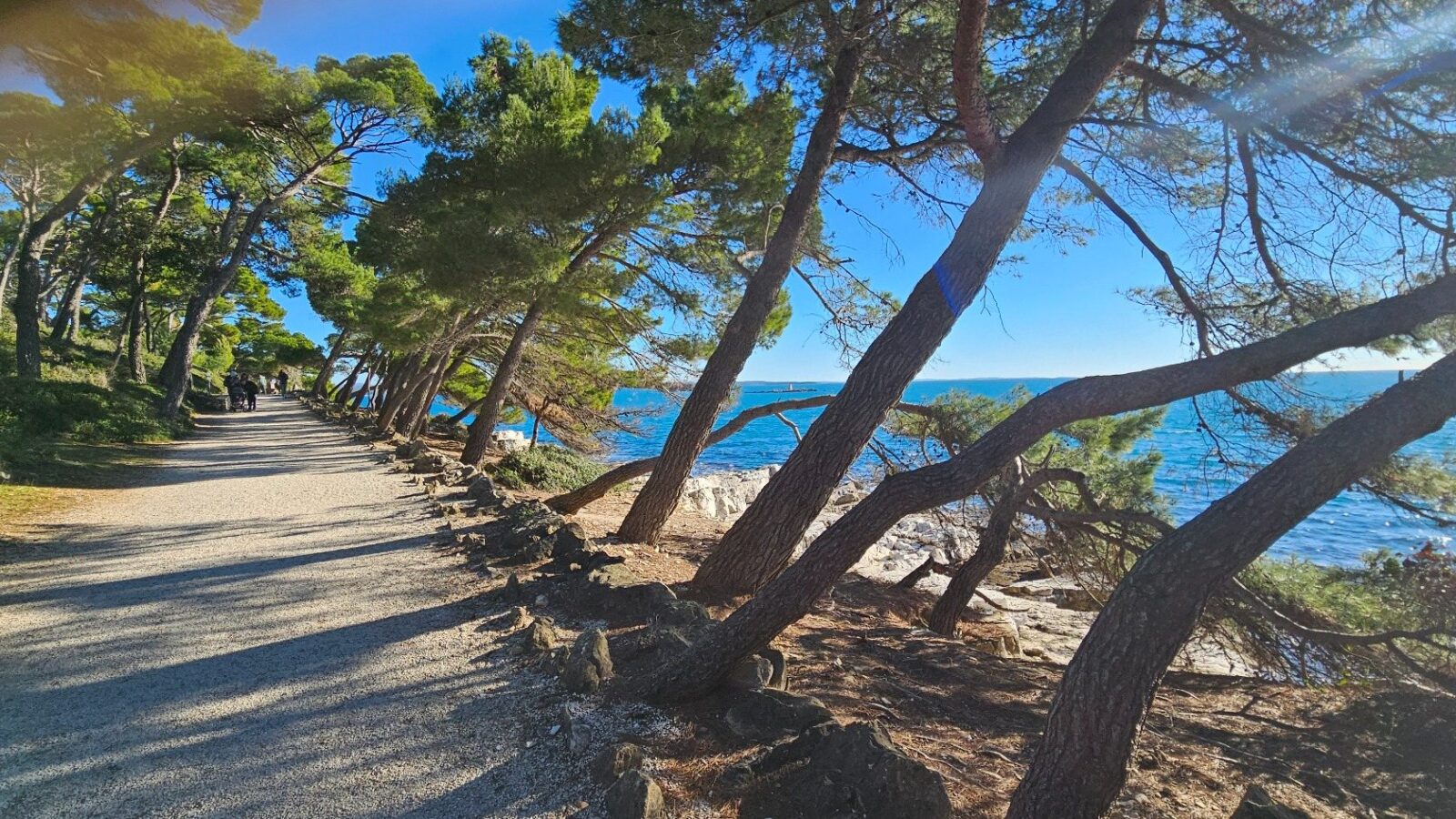
Rovinj is an unusually easy place to explore on foot. The historic centre rewards slow walking, while just south of town the landscape changes quickly into pine forest, broad promenades and rocky Adriatic coastline. You do not need hiking equipment or a car to enjoy the best routes; comfortable shoes, water and enough time are usually more important.
This guide focuses on walking routes around Rovinj beyond the Old Town: Golden Cape Forest Park (Zlatni rt / Punta Corrente), Škaraba, Lone Bay and the coast toward Cuvi. If you want a step-by-step sightseeing route through the historic centre, use our separate Rovinj Old Town Walking Route.
Is Rovinj good for walking?
Yes. For most visitors, walking is the easiest way to combine the centre, waterfront, beaches and nearby nature. The main difference is terrain: the Old Town has polished stone, slopes and steps, while the south-coast routes are mostly flatter promenades, compact gravel and forest paths, with rougher rocky sections only when you leave the main tracks.
Rovinj is not a mountain-hiking destination. Think of these as scenic coastal and forest walks rather than technical hikes. That makes them suitable for a wide range of visitors, including families, couples, runners and travellers staying in town without a car.
The best walking area: Golden Cape Forest Park
Golden Cape, known in Croatian as Zlatni rt and in Italian as Punta Corrente, is the most useful place to start. The protected landscape begins just south of Rovinj’s hotel zone and extends around Lone Bay, Montauro, Punta Corrente and toward Škaraba.
The park developed from the late 19th century, when Georg Hütterott began landscaping and planting the area. Today it contains pine, cypress, laurel and several introduced tree species, with broad avenues, smaller forest paths, lawns and easy access to the sea. Natura Histrica lists Golden Cape as a protected park-forest, with Škaraba continuing the protected green belt farther south.
For a broader introduction to the landscape and its protection rules, see Parks in Rovinj.
Route 1: Waterfront to Lone Bay and Golden Cape
Best for: first-time visitors, families, an easy morning or evening walk.
Start on Rovinj’s central waterfront and walk south past the marina and hotel area toward Lone Bay. The official Istria tourism portal describes Lone Bay as roughly a 15-minute walk from the centre, although your actual time depends on where you start and how often you stop.
Once you reach Lone Bay, continue into Golden Cape rather than turning back immediately. The main promenades are broad and easy to follow. You can make a flexible loop through the forest, stop at the coast, then return toward town by a different path.
Allow around 1.5 to 2.5 hours for a relaxed outing with pauses. In summer, this route works best early in the morning or later in the afternoon, when the waterfront is cooler and the forest is quieter.
Route 2: Golden Cape to Kurent, Montauro and Škaraba
Best for: visitors who want a longer nature walk without leaving Rovinj.
From Lone Bay, continue deeper around the Golden Cape shoreline toward Kurent and Montauro. The route mixes forest shade, open sea views and rocky coves. The old quarry at Montauro is also a well-known climbing area, so do not wander onto climbing lines or treat the rock faces as casual shortcuts.
Continue toward Škaraba if you want a quieter extension. Škaraba forms a natural continuation of Golden Cape and has its own protected park-forest status. The landscape feels less manicured than the busiest part of Golden Cape, with more woodland and rocky coast.
This is a good two- to three-hour walk if you keep moving, but it can easily become a half-day outing once you add swimming, photography or a long break under the trees.
Route 3: Golden Cape to Cuvi and the south coast
Best for: walkers who want more distance and fewer Old Town streets.
For a longer outing, continue south from the Golden Cape and Škaraba area toward Cuvi. The terrain remains mostly gentle, but services become more spread out and the route is less of a simple city promenade.
Cuvi is useful as a turning point because it combines beach access with a clear connection back toward Rovinj’s residential and hotel areas. If you continue farther south toward Villas Rubin, Polari or Veštar, the day starts to feel more like a recreational coastal excursion than a short city walk.
Do not assume every shoreline shortcut is faster. Around rocky sections, the established inland path is often the more comfortable and safer option.
Route 4: Combine an Old Town walk with the coast
If you have only one full day in Rovinj, the best walking plan is usually not one long route. Split the day into two different landscapes: the Old Town in the cooler morning hours, then the waterfront and Golden Cape later.
The historic centre gives you Balbi’s Arch, Grisia, St. Euphemia and narrow stone streets. Golden Cape gives you shade, sea air and open space. Together they show why Rovinj works especially well as a destination for visitors who prefer to explore without a car.
For transport planning beyond walking, see Rovinj Without a Car.
What the paths are really like
Main routes through Golden Cape are generally broad and easy, with compact gravel or firm natural surfaces. They are used by walkers, runners and cyclists, so keep to one side and expect mixed traffic in busy periods.
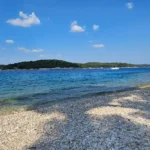
Closer to the shoreline, surfaces can become uneven. Rocky access points, pine roots and loose stones are normal, especially if you leave the main promenade. After rain, both rock and polished stone can be slippery.
- Normal walking shoes or trainers: enough for the main promenades.
- Sandals: fine for short summer strolls, less useful on longer gravel routes.
- Flip-flops: better kept for the beach rather than a two-hour walk.
- Strollers: work best on broad park paths; shoreline shortcuts can be rough.
Walking in summer
Golden Cape is one of Rovinj’s best summer walking areas because of its trees, but shade does not remove the heat. In July and August, avoid turning a midday walk into an endurance test. Go early, walk after 17:00, or plan a swim break.
Carry water even if you expect to find a café later. Seasonal facilities exist around the more popular bays, but opening hours and services vary outside the main summer period.
If swimming is part of the plan, use Best Beaches in Rovinj to choose a beach that suits your group rather than entering the sea from the first rocky point you see.
Spring, autumn and winter walks
Spring is arguably the best season for longer walks: the days are comfortable, the vegetation is fresh and the coastline is not yet at peak summer density.
September and early autumn are also excellent because the sea can still be warm enough for swimming while walking temperatures become more pleasant.
Winter can be very good for short forest walks on calm, dry days. Expect fewer open beach facilities, earlier darkness and more exposure to bora or jugo conditions along open sections of coast.
Can you cycle the same routes?
Many Golden Cape and south-coast paths are shared with cyclists. If you prefer to cover more distance, cycling is often the better choice, but walking gives you more freedom to stop at small coves and viewpoints.
For bike-specific routes, rentals and practical advice, use Cycling in Rovinj.
Protected-area rules matter
Golden Cape and Škaraba are protected landscapes, not ordinary urban parks. Natura Histrica’s current rules prohibit damaging vegetation, leaving waste, lighting fires and driving motor vehicles inside the park except for authorised or emergency access.
Stay on existing paths, respect signs and temporary restrictions, and do not create new shortcuts through vegetation. Current protected-area information is available from Natura Histrica.
Who will enjoy walking in Rovinj most?
- Visitors without a car who want nature within walking distance of the centre.
- Couples looking for a relaxed coastal route before dinner or sunset.
- Families who prefer shade and open space to long periods on Old Town stone.
- Runners and active travellers who want a flexible route with little traffic.
- Photographers who want changing views of the islands, pine forest and rocky coast.
Practical local tips before you set out
- Download or save a map before a long walk; mobile signal is usually available, but you should not depend on it for every turn.
- Carry water outside peak summer too, especially if you continue beyond the busiest part of Golden Cape.
- Use the main paths after rain; coastal rock becomes slippery.
- Do not plan a strict distance if swimming is part of the day. Beach stops change the pace completely.
- In high summer, start early enough to avoid the hottest part of the day.
- If you are staying centrally, walk to Golden Cape rather than driving just to start the route.
Which walk should you choose?
If you want the easiest introduction, walk from the waterfront to Lone Bay and make a short Golden Cape loop. If you want more nature, continue toward Kurent, Montauro and Škaraba. If you want a longer active half-day, extend toward Cuvi.
The main advantage is flexibility: you can turn around almost anywhere without losing the experience. Rovinj’s best walking routes are not about reaching one summit or landmark; they are about moving gradually from the town into forest and along the sea.
Last updated: September 2026