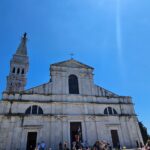
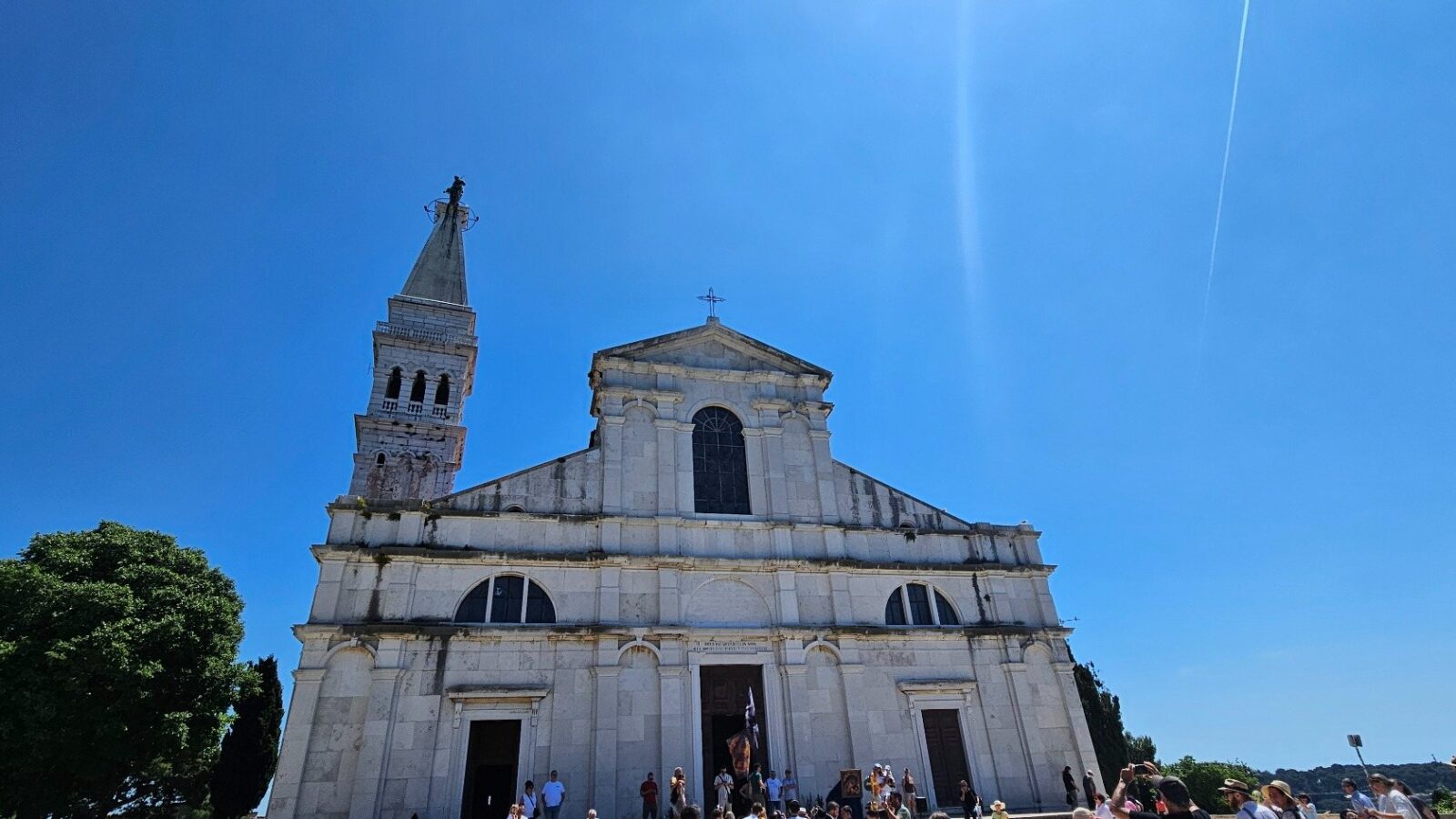
The Church of St. Euphemia is the landmark that defines Rovinj’s skyline. Standing at the highest point of the Old Town, the large Baroque parish church and its 60-metre bell tower are visible from the harbour, the islands and much of the surrounding coast. For first-time visitors, this is one of the few sights in Rovinj that is worth visiting both for its history and for the setting around it.
The church is still an active place of worship, not simply a monument. That matters when you plan a visit: services, feast-day celebrations, concerts and parish events can affect visitor access, and bell-tower opening arrangements may change with the season.
Read more: Rovinj Old Town
Quick visitor guide
- Where: at the top of Rovinj Old Town, on Trg sv. Eufemije.
- Why visit: Baroque architecture, the shrine and sarcophagus of St. Euphemia, the historic bell tower, and wide views over Rovinj and the Adriatic.
- How to reach it: on foot through the Old Town; Grisia is the classic uphill approach.
- Walking conditions: steep lanes, polished stone and steps in places.
- Best time: early morning or later afternoon for a cooler, quieter walk in summer.
- Bell tower: access and any admission charge can vary; check current conditions on the day.
- Feast day: 16 September, when Rovinj celebrates its patron saint.
Why St. Euphemia matters to Rovinj
St. Euphemia is more than the name of Rovinj’s largest church. She is the patron saint of the town and parish, and her story has been part of Rovinj’s civic and religious identity for more than a thousand years.
According to local tradition, a marble sarcophagus containing the saint’s relics reached the Rovinj coast in the year 800. The best-known version of the legend says that townspeople could not move the heavy sarcophagus until a boy, following a vision of the saint, drew it up the hill with two young cattle. The sarcophagus is still kept in the church today.
The story belongs to religious tradition rather than modern documentary history, but its cultural importance in Rovinj is very real. St. Euphemia’s feast on 16 September remains one of the most important dates in the local calendar.
A short history of the church
There was a much older church on this hill before the present building. The parish records that the earlier church was associated with St. George, Rovinj’s protector before devotion to St. Euphemia became central to the town.
As Rovinj expanded, the older sanctuary became too small. The present parish church was built between 1725 and 1736 to a design associated with Giovanni Dozzi. The result is the monumental Baroque church that still dominates the Old Town.
The bell tower is older than the main 18th-century church building. Its Venetian form is one of the clearest visual reminders of Rovinj’s long historical connection with the Adriatic world. Official Istrian tourism material gives the tower a height of about 60 metres. The copper statue of St. Euphemia at the top turns with the wind.
What to look for inside
The interior deserves more than a quick photograph. The most important object is the marble sarcophagus of St. Euphemia, kept in the church choir behind the saint’s altar. Official cultural material for Rovinj identifies the sarcophagus as Proconnesian marble dating from late antiquity.
The church also contains a rich Baroque interior with side altars, sculpture and decorative work. Another important feature is the historic Antonio Barbini organ from 1754. The instrument was restored and returned to use in 2025, and it continues to feature in concerts and organ events.
If you visit while a service is taking place, sightseeing should come second. Stay quietly at the back or return later rather than moving around the nave during Mass.
The bell tower: should you climb it?
For many visitors, the bell tower is the most memorable part of the visit. When access is open, the climb gives a high view over the red roofs of the Old Town, the harbour, the Rovinj archipelago and the surrounding coastline.
The climb is not suitable for everyone. Historic bell towers can involve narrow passages, steep steps and open wooden stair sections. If you dislike heights, have reduced mobility, or are visiting with very young children, the church square itself already gives excellent views without the climb.
Do not rely on a fixed price or opening timetable copied from an old travel page. Current public information is inconsistent and the church remains an active parish. Check locally or with the parish shortly before your visit.
Read more: Best Viewpoints in Rovinj
How to walk to St. Euphemia
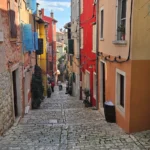
The church sits at the top of the historic peninsula, so nearly every approach involves an uphill section. The classic route starts near Marshal Tito Square and Balbi’s Arch, then climbs through the Old Town via Grisia Street.
Grisia is attractive but its polished stone can be slippery, especially after rain. Comfortable shoes with grip are more useful than thin-soled sandals. In July and August, the climb is noticeably easier before the strongest midday heat.
A good alternative is to go up one route and come down another. After visiting the church, descend through quieter lanes around Bregovita or Casale and return toward the western waterfront.
Read more: Rovinj Old Town Walking Route
Parking and access
You cannot treat St. Euphemia as a drive-up attraction. The historic centre is primarily pedestrian and vehicles do not simply park beside the church for sightseeing. If you arrive by car, use a public parking area outside the Old Town and continue on foot.
Visitors with reduced mobility should plan carefully. The lower waterfront and central squares are considerably easier than the full uphill route to the church. Old stone paving, gradients and steps can make the final approach difficult for wheelchairs and some mobility aids.
For families with babies or toddlers, a carrier is often easier than a large stroller on the steepest lanes.
Read more: Where to Park in Rovinj
Best time to visit
Summer
Visit early in the morning or later in the afternoon if you want a more comfortable climb and fewer people around the church square. Midday can be hot and the main Old Town route is busiest in peak season.
Spring and early autumn
These are especially good periods for combining St. Euphemia with a longer Old Town walk. Temperatures are usually more comfortable and the streets are easier to explore at a slower pace.
16 September: St. Euphemia’s feast
This is not a normal sightseeing day. It is a major religious and civic celebration. In 2026, the city programme around St. Euphemia and City Day ran from 11 to 17 September, while the parish celebrated the feast itself on 16 September with several Masses and a central solemn service. If you visit at this time, expect more people, religious observances and changes to ordinary visitor access.
Church etiquette
- Wear clothing appropriate for an active church rather than beachwear.
- Keep voices low inside.
- Do not walk in front of worshippers or through a service for photographs.
- Avoid flash photography unless it is clearly permitted.
- Remove hats inside.
- If a wedding, funeral or Mass is taking place, return later if possible.
What to combine with St. Euphemia
The church works best as part of an Old Town visit rather than as an isolated stop. A practical sequence is:
- Marshal Tito Square and the waterfront
- Balbi’s Arch
- Grisia Street
- Church of St. Euphemia
- the hilltop viewpoints
- a quieter descent toward the western seafront
- the harbour and Batana area
Allow roughly two to three hours if you want to enjoy the route without rushing. If you are interested in Rovinj’s wider religious heritage, continue with the Franciscan Monastery and smaller historic churches elsewhere in town.
Read more: Churches in Rovinj
Read more: Rovinj Harbour
Practical local tips
- The square around the church is worth visiting even if the interior or tower is temporarily closed.
- Bring water in hot weather; the climb is short but exposed in places.
- After rain, slow down on polished stone streets.
- For photographs of the church within the wider skyline, views from the harbour and across the bay are often more useful than standing directly below the tower.
- For sunset, the church area can be beautiful, but the descent through dark polished lanes deserves extra care.
- Check the parish website for current liturgy and special events if your visit is tied to a specific time.
Official information checked
This September 2026 update was checked against the official Parish of St. Euphemia in Rovinj, its parish history, and the official Istria tourism page for the Church of St. Euphemia. The 2026 feast-day information was also checked against current parish and City of Rovinj-Rovigno announcements.
Last updated: September 2026