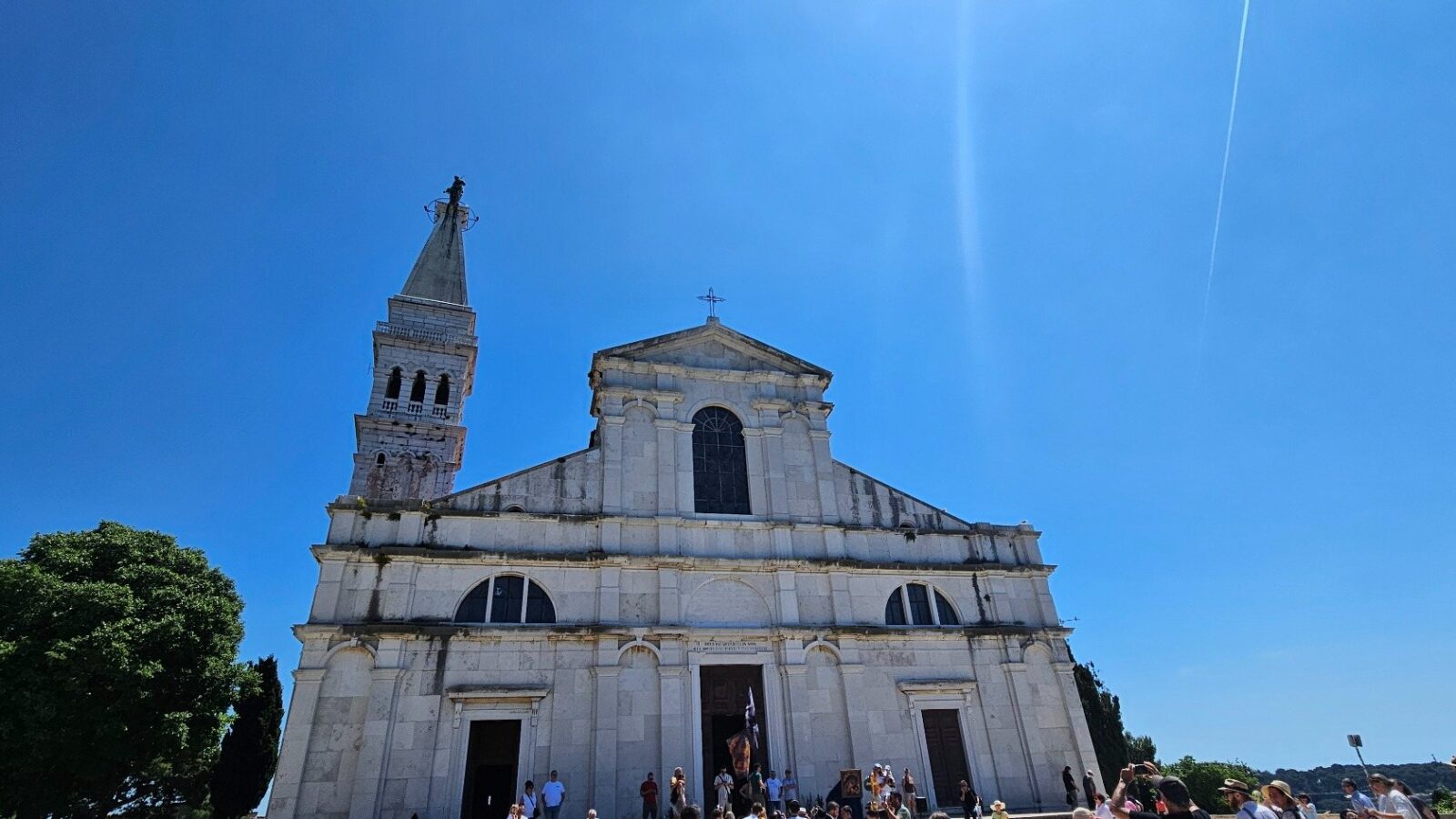
Rovinj’s churches are part of the city’s everyday skyline, but they also explain how the town grew. The monumental Church of St. Euphemia crowns the Old Town, while smaller churches, chapels and the Franciscan complex are woven into streets that developed on both sides of the former channel separating the old island settlement from the mainland.
For most visitors, the best way to explore Rovinj’s religious heritage is not to try to see every building. Combine the major landmark of St. Euphemia with the Franciscan Monastery and a few smaller churches that fit naturally into an Old Town walk. Some remain active places of worship, while others are used as galleries, ateliers or exhibition spaces, so access can vary.
For broader context before you start, see our guide to Rovinj Old Town and our local guide to Rovinj.
The most important churches in Rovinj
Church of St. Euphemia
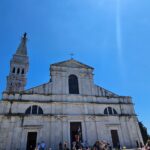
The Church of St. Euphemia is Rovinj’s defining landmark and the most important church for first-time visitors. It stands at the highest point of the historic peninsula, above the dense roofs of the Old Town, and is visible from much of the waterfront.
The present Venetian Baroque church was rebuilt in the 18th century, while the site has a much longer religious history. According to official Rovinj tourism material, an earlier chapel dedicated to St. George stood here before the cult of St. Euphemia became central to the town. The saint is Rovinj’s patron, and the local tradition surrounding her sarcophagus remains one of the city’s best-known historical legends.
The bell tower is almost as recognisable as the church itself. Construction began in the 17th century and its design was inspired by the campanile of St. Mark’s in Venice. The copper statue of St. Euphemia at the top was installed in the 18th century and is designed to turn with the wind.
Even if you are not visiting for religious reasons, the church is worth including for three reasons: its importance to Rovinj’s identity, the Baroque interior and the views from the hilltop area around it. If bell-tower access is available during your visit, check the current conditions locally before climbing, because opening arrangements can change.
St. Euphemia’s feast day is 16 September, an important date in Rovinj’s civic and religious calendar. Visitors travelling around that time should expect a livelier atmosphere and possible changes to normal access during services and celebrations.
Read more: Church of St. Euphemia in Rovinj
Franciscan Monastery and Church of St. Francis
The Franciscan complex is the second major religious site to prioritise. It stands on the mainland side of historic Rovinj and reflects the period when the settlement expanded beyond the former island core.
Construction of the church and hospice began in 1702. The church was completed and blessed in 1710, the hospice became a monastery in 1746, and the church was consecrated in 1750. The complex later developed with a library, refectory, dormitory and cloisters.
Its value is not limited to architecture. The monastery collection includes liturgical objects, books, paintings and sculpture. Rovinj Tourist Board’s organised city tours have included the Church of St. Francis and the monastery collection, which confirms its importance within the city’s cultural heritage.
Visitor access to the collection may depend on current opening arrangements, guided visits or events. Do not assume that every part of the monastery is freely accessible throughout the day.
Church of the Holy Trinity
The Church of the Holy Trinity is one of Rovinj’s most distinctive smaller historic buildings. The official cultural itinerary describes it as a heptagonal Romanesque church with a circular interior, seven niches and a domed space beneath a conical roof.
One of its notable details is a preserved stone window transenna with a religious scene. The building is no longer used for regular worship and has been used as a gallery, which makes it a good example of how Rovinj has adapted older religious architecture for cultural use.
This is not a monument that requires a long visit. It works best as part of a wider walk through central Rovinj, especially for visitors interested in architecture and small historic buildings.
Church of Our Lady of Mercy
The Church of Our Lady of Mercy is another useful stop outside the most visited part of the Old Town. Its exact construction date is uncertain, but official Rovinj heritage material records that it was consecrated in 1487 and later reconstructed in the 16th century.
The interior is particularly interesting for its links with Rovinj’s maritime history. Historic wooden benches and votive offerings recall the close relationship between the town, seafaring families and religious devotion. The church also contains an altar painting of Our Lady of Mercy dated 1567.
Because this is a smaller church rather than a major ticketed attraction, opening can be less predictable. If the doors are closed, it is still worth appreciating the exterior and including the stop within a broader heritage walk.
Church of St. Benedict
St. Benedict is a small 15th-century church in the historic centre, near the area known as Pod lukovima. Monks from the monastery on St. Andrew’s Island once served here.
Today the building is used as an atelier rather than a regular place of worship. That change of use is part of what makes Rovinj’s smaller churches interesting: several survive as cultural spaces integrated into the Old Town instead of functioning only as monuments.
Church of the Holy Cross
Along Ulica Sv. Križa in the Old Town, the small Church of the Holy Cross is easy to combine with a walk between the waterfront streets and St. Euphemia. Official tourist material describes the medieval church as having an elegant loggia and a small collection of stone monuments and inscriptions.
The setting is as important as the building itself. This part of the Old Town shows how churches, houses, lanes and the rocky shoreline developed very close together.
Church of St. Thomas
The medieval Church of St. Thomas was reconstructed in the early 18th century. Its unusual access from the upper street level and its later use for exhibitions make it another good example of a religious building that has taken on a cultural role.
You do not need to seek it out on a short first visit, but it is worth adding if you enjoy architectural details or are spending several days in Rovinj.
Which Rovinj churches are most worth visiting?
If your time is limited, prioritise the following:
- St. Euphemia: essential for almost every first visit to Rovinj.
- Franciscan Monastery and St. Francis: best for visitors interested in local religious art, books and monastery history.
- Holy Trinity: a compact architectural stop with a different character from the larger Baroque churches.
- Our Lady of Mercy: especially interesting for its connection with Rovinj’s maritime past.
The smaller churches of St. Benedict, Holy Cross and St. Thomas are best treated as discoveries along a walking route rather than as separate half-day attractions.
A practical walking route for Rovinj’s churches
A comfortable route is to start on the mainland side of the historic centre with the Franciscan Monastery and one or two smaller churches nearby, then continue towards the Old Town. Enter the historic core, include St. Benedict or Holy Cross if they fit naturally into your path, and finish by climbing through the old streets to St. Euphemia.
This route gives you a useful historical sequence: the expanded mainland town, the lower historic centre and finally the hilltop parish church that dominates Rovinj’s skyline.
Allow roughly two to three hours if you want to walk at an easy pace, stop for photos and enter buildings that happen to be open. Add more time if you are combining the route with museums, lunch or the waterfront.
For a ready-made day structure, our Rovinj in one day itinerary can help you combine the churches with the harbour and other central sights.
Visiting active churches: practical etiquette
Some Rovinj churches remain active religious spaces. Dress and behaviour should reflect that, especially during Mass, weddings, funerals or feast-day services.
- Keep voices low inside active churches.
- Avoid walking through a service simply to take photographs.
- Use discreet clothing that covers shoulders and more than beachwear when entering a church.
- Check whether photography is permitted before using flash or photographing worshippers.
- If a smaller church is closed, do not assume it is permanently inaccessible; opening may depend on services, exhibitions or seasonal arrangements.
Accessibility and walking conditions
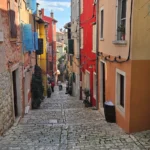
Rovinj’s church route is easiest for visitors comfortable with walking. The Old Town has polished stone paving, steps, slopes and uneven surfaces. The approach to St. Euphemia is uphill, and some smaller lanes can be awkward for large strollers or visitors with reduced mobility.
Lower-town churches are generally easier to approach than the hilltop church, but individual thresholds and historic interiors may still present barriers. If accessibility is important, check current conditions for the specific church before setting out.
Best time to explore Rovinj’s churches
Spring and early autumn are particularly comfortable for walking because temperatures are usually milder and the Old Town is less crowded than at the height of summer.
In July and August, start early if you want quieter streets and a cooler climb to St. Euphemia. In winter, the historic centre is much calmer, but smaller churches and cultural spaces may have more limited visitor access.
Religious feast days and local events can change the atmosphere completely. St. Euphemia’s feast on 16 September is the clearest example: it is an important local occasion rather than an ordinary sightseeing day.
Who will enjoy this route most?
A church-focused walk works especially well for visitors interested in architecture, local history, art, photography and the way Rovinj developed from a compact island settlement into a larger town. It is also a useful option on a cooler or partly cloudy day when you want more than beaches and waterfront time.
Families can include one or two churches without turning the day into a formal heritage tour. For most children, St. Euphemia and the hilltop views are likely to be more engaging than trying to visit every small chapel.
Combine churches with other Rovinj sights
Rovinj’s churches make most sense when combined with the surrounding streets rather than visited in isolation. Pair St. Euphemia with Grisia, the Old Town viewpoints and the waterfront. Combine the Franciscan complex with the central town area, then continue towards Balbi’s Arch and the historic peninsula.
For more ideas, see our best things to do in Rovinj.
Final tips
Do not plan your day around exact church opening hours unless you have verified them shortly before your visit. Smaller churches in particular may open only for services, exhibitions, guided visits or special events. The safest approach is to build the churches into a wider walking route so the day still works even if one door is closed.
If you only see one, make it St. Euphemia. If you have more time, add the Franciscan Monastery and then choose one or two smaller churches for a more complete picture of Rovinj’s religious and architectural history.
Sources
- Rovinj Tourist Board – Cultural and Historical Sights
- Rovinj Tourist Board – Cultural and Historical Itineraries
- Rovinj Tourist Board – Feel the Breeze of Rovinj
- Rovinj Tourist Board – The Legend of St. Euphemia
Last updated: September 2026