Balbi’s Arch is one of those Rovinj landmarks that many visitors pass through before they realise what they are looking at. Standing at the edge of the historic centre, it forms a symbolic gateway between the main town square and the steep lanes of the Old Town.
It is not a ticketed attraction and you do not need to plan a separate visit around it. Instead, treat the arch as the natural starting point for exploring Rovinj Old Town. Spend a few minutes looking closely at the stonework, the Venetian lion, the carved heads and the Balbi family coats of arms before continuing uphill.
Balbi’s Arch at a glance
| Location | Entrance to Rovinj Old Town from the central town square |
|---|---|
| Built | 1678–1679 |
| Style | Baroque Venetian stone arch |
| Earlier site | Old Fish Market Gate, part of Rovinj’s former fortified entrance system |
| Cost | Free; the arch is part of the public pedestrian route into the Old Town |
| Time needed | 5–15 minutes, or simply include it in a longer Old Town walk |
| Best combined with | Grisia Street, St. Euphemia, the Old Town lanes and Rovinj Harbour |
Why Balbi’s Arch matters
Rovinj’s Old Town was once a fortified settlement with walls and a series of town gates. The arch stands on the site of the former Old Fish Market Gate, one of the principal entrances into the historic core.
The present structure dates from 1678–1679, when the earlier gate was replaced by the stone-clad Baroque arch visible today. Its position still makes sense when you approach from the main square: pass beneath it and the character of Rovinj changes almost immediately from open waterfront space to narrow, rising Old Town streets.
The official City of Rovinj-Rovigno landmarks guide records the arch as part of the town’s historic system of walls and gates and describes the details that were added over time.
What to look for on the arch
Balbi’s Arch is small enough to cross in seconds, but several details are worth stopping for.
The Venetian lion
Above the opening is a stone Lion of St. Mark, the emblem most strongly associated with Venice and its former territories. Rovinj spent centuries under Venetian rule, and traces of that period remain throughout the Old Town in architecture, coats of arms and urban details.
The open book carried by the lion bears the unusual inscription VICTORIA TIBI MARCE EVANGELISTA MEUS. It differs from the formula more commonly seen on Venetian lions, which is one reason this particular carving receives attention in local descriptions of the monument.
The two carved heads
Look closely at the keystone area as you approach and then again after you pass through. The two sculpted heads are traditionally described as having a “Turkish” character on the outer side and a “Venetian” character on the inner side.
The detail is easy to miss if you are walking directly uphill, so step slightly back from the arch on each side and look upward.
The Balbi family coats of arms
The name “Balbi’s Arch” came later than the original construction. About a century after the arch was built, coats of arms connected with the Balbi family were added to the upper part of the structure. Those later additions are what eventually gave the gateway the name used today.
The setting is part of the monument
The arch makes more sense when viewed as part of the surrounding town rather than as an isolated object. On one side is the broad central square and waterfront; on the other, the compact medieval street pattern rises toward the hilltop church. It is a physical transition between two very different spaces.
Where is Balbi’s Arch?
Balbi’s Arch is beside Rovinj’s central town square, at the main pedestrian entrance into the historic centre. If you are walking along the waterfront or coming from the harbour, it is only a short detour from the promenade.
You do not need navigation once you are in the centre. From the square, look toward the cluster of Old Town buildings and the uphill route leading toward Grisia. The arch is the historic gateway at that transition point.
If this is your first visit, our self-guided Rovinj Old Town walking route gives a simple way to use Balbi’s Arch as the beginning of a longer walk.
How long should you spend here?
For most visitors, five to fifteen minutes is enough. Balbi’s Arch is not a monument that requires a lengthy visit, interior tour or ticket. Its value comes from understanding what you are passing through.
A good rhythm is to stop on the square side first, look at the upper stonework, pass beneath the arch, turn around to see the opposite carved head, and then continue into the Old Town.
Best time to visit and photograph Balbi’s Arch
The arch can be seen at any time because it forms part of a public pedestrian route. For photographs, early morning is usually the easiest time to find the square and passage relatively quiet, especially in July and August.
Late afternoon can also be attractive when warm light reaches the façades around the square, although pedestrian traffic is normally heavier. At night, the arch becomes part of the evening walk through the centre rather than a major photography stop.
If you want a cleaner photograph, avoid standing directly under the opening. Step back into the square so that the full upper section, lion and surrounding façades fit into the frame.
Accessibility and practical details
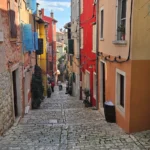
The arch itself sits on the main pedestrian approach to the Old Town and is straightforward to reach from the waterfront. The more difficult part begins after you pass through it: central Rovinj rises uphill and many streets are paved with old, polished stone.
Visitors with reduced mobility, pushchairs or heavy luggage should remember that the route toward the Church of St. Euphemia becomes steeper and less even. After rain, the smooth limestone can also become slippery.
There are no visitor facilities attached to Balbi’s Arch itself. Cafés, shops and services are immediately nearby in the central square and surrounding streets.
A simple Old Town route from Balbi’s Arch
If you have about 60–90 minutes, Balbi’s Arch works well as the first stop in a compact Old Town circuit:
- Start at the waterfront and central square.
- Stop at Balbi’s Arch and look at both sides of the monument.
- Continue uphill through Grisia and the surrounding lanes.
- Reach St. Euphemia and the upper Old Town.
- Descend through quieter side streets rather than retracing the same route.
- Finish beside Rovinj Harbour for a waterfront walk.
If photography is a priority, combine the route with our guide to the best viewpoints in Rovinj.
Is Balbi’s Arch worth visiting?
Yes, but not because it is a large standalone attraction. Balbi’s Arch is worth seeing because it explains how Rovinj’s historic centre developed. In a few metres you can see traces of the fortified town, Venetian rule, later family patronage and the transition from the civic square into the dense Old Town.
Do not make a special journey across Rovinj only for the arch. Instead, notice it properly when you begin an Old Town walk. That small pause gives useful historical context to everything you see farther uphill.
Last updated: September 2026