Rovinj Harbour is not just a place where boats arrive and leave. It is part of the city centre, a working waterfront, a meeting point, a departure point for island and coastal trips, and one of the easiest places to understand Rovinj’s relationship with the sea.
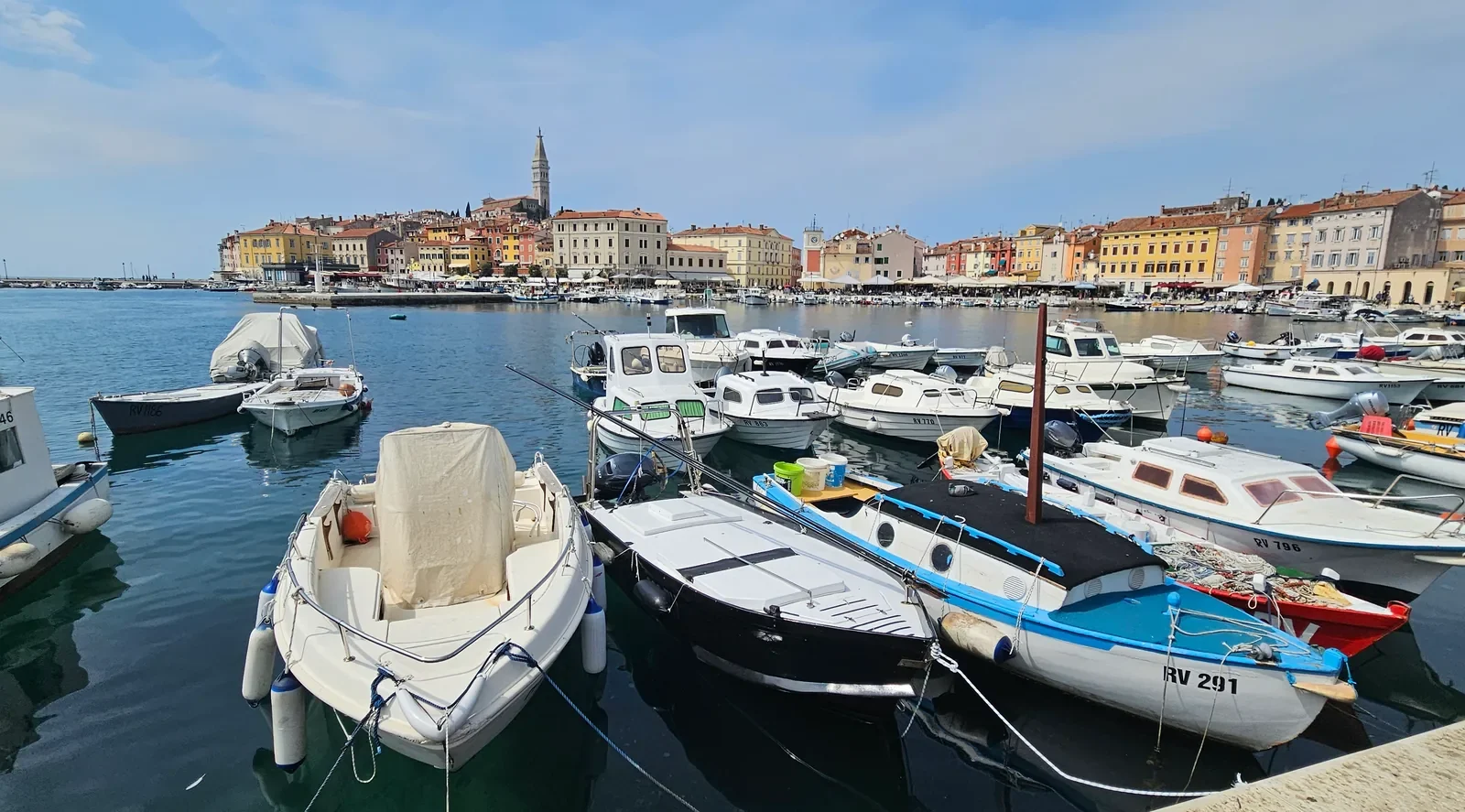
For most visitors, “Rovinj harbour” means the waterfront wrapped around the edge of the historic centre: fishing boats and excursion boats in front of pastel façades, the Old Town rising behind them, Valdibora to the north, and the southern waterfront leading toward the marina and park areas. The official Port of Rovinj is broader than this visitor-facing zone and includes several operational basins and anchorages, so it helps to know which part of the harbour you actually need.
Read more: Discover Rovinj
Quick answer: where is Rovinj Harbour?
The central harbour sits directly beside Rovinj’s historic centre. If you are already around Marshal Tito Square, Balbi’s Arch or the lower streets of the Old Town, you are only a few steps from the waterfront.
The harbour is easiest to think of in three visitor-friendly sections:
- The historic central waterfront — the most photogenic section, with small boats, excursion boats, cafés and views toward the Old Town.
- Valdibora — the northern harbour area, beside the open space and parking zone north of the Old Town. It is an important operational part of the port and is also useful for visitors arriving by car or walking toward the northern side of the centre.
- The southern waterfront — the stretch leading away from the centre toward the marina, hotels and eventually the green areas around Golden Cape.
The Rovinj Port Authority describes its jurisdiction as including the South Port Andana, North Port Valdibora, Valdibora anchorages and several other coastal and island berthing areas. For a sightseeing walk, however, you do not need to understand the full port map: the central waterfront can be explored comfortably on foot.
Why the harbour matters to Rovinj
Rovinj grew as a maritime town, and the harbour still shows that identity more clearly than many polished resort promenades. Traditional small boats share the water with modern motorboats, excursion vessels and visiting yachts. The most distinctive local boat is the batana, a flat-bottomed wooden fishing boat closely associated with Rovinj’s coastal heritage.
Local sources describe the southern harbour as a place where traditional batanas remain a familiar part of the scene. Historically, the waterfront south of the centre also had numerous small shipyards, reflecting the city’s long tradition of boatbuilding.
This is why the harbour works particularly well as more than a photo stop. It connects the Old Town, local maritime culture, food, boat excursions and everyday movement through the city.
The best way to explore Rovinj Harbour on foot
1. Start at Valdibora
Valdibora is a practical starting point if you are arriving from the north side of town or from nearby parking areas. From here you get an excellent first view of the Old Town mass rising from the peninsula.
Walk toward the historic centre rather than rushing straight into the narrow streets. The changing angle across the water is one of the best ways to appreciate Rovinj’s skyline.
Read more: Best Viewpoints in Rovinj
2. Continue along the central waterfront
The harbour edge around the centre is where the maritime and urban sides of Rovinj meet most clearly. Small boats sit in front of colourful façades, restaurant terraces line parts of the waterfront, and the Church of St. Euphemia remains visible above the rooftops from many angles.
This stretch is particularly pleasant in the early morning before the centre becomes busy, or in late afternoon when the light softens across the façades.
3. Detour into the Old Town
The harbour and Old Town are best treated as one experience. From the waterfront you can enter the historic centre, climb through the stone lanes toward St. Euphemia and then return to sea level by a different route.
Read more: Rovinj Old Town
4. Walk south toward the marina and green coastline
If you have more time, continue south along the waterfront. The character gradually changes from the compact historic harbour to a more open promenade with views toward the marina, St Catherine Island and the greener coastline beyond.
This makes a natural link between sightseeing in the centre and a longer walk toward Golden Cape.
Read more: Parks in Rovinj
Boat trips and island departures
The harbour is one of the places where visitors naturally start looking for boat excursions. Depending on season and operator, you may see offers for island trips, dolphin-watching cruises, sunset trips, Lim Channel excursions and other coastal routes.
Departure points are not all identical. Some boats use the central piers, while other services may depart from different parts of the waterfront. Always check the exact meeting point printed on your booking rather than assuming every trip leaves from the same pier.
For regular island connections and excursion choices, compare the route, trip length, return arrangements and what is actually included before booking.
Read more: Rovinj Boat Trips
Read more: Rovinj Islands
Rovinj’s batana heritage
The harbour is also one of the best places to notice Rovinj’s traditional batana boats. These low wooden boats are part of the city’s living maritime identity rather than simply decorative objects.
The Ecomuseum Batana organises heritage activities connected with traditional boats and local seafaring culture. In summer, programmes have included batana boat rides from the Small Pier and heritage evenings around the Great Pier. Event dates and operating details vary, so check the current programme before planning a visit around a specific activity.
If maritime culture interests you, the harbour is worth walking slowly rather than treating it only as a route between restaurants and the Old Town.
Can you see cruise ships and large yachts?
Yes, although what you see changes from day to day. The Rovinj Port Authority lists Valdibora and Andana among the operational areas used by yachts, mega-yachts and cruise vessels. Large vessels can therefore become a very visible part of the harbour scene when they are in port.
The official port information lists the cruise port as open 24 hours, but that does not mean cruise ships are present every day. Arrivals depend on schedules, weather and port operations.
Parking and access
The historic centre is best explored on foot. If you arrive by car, do not plan on driving directly along the Old Town lanes or using the harbour edge as a sightseeing road. Use designated parking and continue on foot.
Valdibora is one of the most useful orientation points for drivers because it sits immediately north of the Old Town and harbour. Parking rules, zones and prices can change seasonally, so use the dedicated parking guide for current details rather than relying on old screenshots or forum posts.
Read more: Where to Park in Rovinj
Accessibility and walking conditions
The main waterfront is much easier to navigate than the steep interior of the Old Town. It is largely level, making it a good choice for visitors who want Rovinj views without climbing many stone streets.
However, expect busy pedestrian areas in summer, occasional service vehicles, boat activity near the quay and polished stone surfaces that can be slippery when wet. Keep children close near the water’s edge, especially around working piers.
Best time of day to visit
Early morning is best for a quieter walk, fishing-boat atmosphere and unobstructed photos.
Late afternoon is ideal if you want to combine the harbour with the Old Town and dinner.
Evening brings a livelier promenade, restaurant terraces and reflections across the water.
For sunset itself, the best view depends on the season and where the sun is setting relative to the peninsula. The harbour can be beautiful, but it is not the only strong sunset position in Rovinj.
Read more: Rovinj Sunset
Seasonal differences
Summer brings the greatest number of excursion boats, passengers, yachts and evening activity. The harbour can feel busy, especially around departure times and after sunset.
Spring and early autumn are generally easier for relaxed walking while still offering plenty of maritime activity. In winter, excursion traffic is much quieter and many visitor-oriented services operate on reduced schedules, but the harbour remains an atmospheric part of the city and can feel more local.
Current port works and changing conditions
The Rovinj Port Authority launched a major infrastructure project for a new north breakwater at St Catherine Island in late 2025, with the stated aim of improving harbour protection, maritime safety and access to the island. Port projects can temporarily change working areas, vessel movements or access around specific waterfront points.
Visitors normally do not need to plan around port operations, but if you are travelling by private yacht, organising a marine service or depending on a particular berth or pier, check current information directly with the Rovinj Port Authority before arrival.
Who will enjoy the harbour most?
- First-time visitors — it is one of the easiest introductions to Rovinj.
- Photographers — reflections, boats and the Old Town skyline change throughout the day.
- Families — the level promenade is easier than many Old Town streets, though care is needed near quay edges.
- Couples — it works naturally for an evening walk before or after dinner.
- Boat-trip visitors — it helps to understand the different piers and waterfront zones before departure.
- Travellers interested in local culture — the batana tradition gives the harbour a strong connection to Rovinj’s maritime identity.
Things to know before you go
- “Rovinj harbour” is a broad term; your boat departure may use a specific pier or another waterfront zone.
- Do not assume the central harbour and the marina are the same place.
- In high season, allow extra time to find the correct meeting point for excursions.
- Stone paving can become slippery after rain.
- The harbour is a working maritime area, so respect barriers and operational zones.
- If you are arriving by private boat, use official Port Authority information rather than visitor-blog advice for berthing and navigation.
Is Rovinj Harbour worth visiting?
Yes. Even if you are not taking a boat trip, the harbour deserves time because it connects several of Rovinj’s strongest experiences in one compact area: the Old Town skyline, local boats, waterfront life, island views and maritime heritage.
The best approach is simple: walk it rather than just photograph it. Start at Valdibora, follow the water past the historic centre, detour into the Old Town, and continue south if you have time. In less than a few hours, you can see how closely Rovinj’s everyday identity is tied to the sea.
Official sources checked
- Rovinj Port Authority — port areas, cruise port and contact information
- Rovinj Port Authority — St Catherine north breakwater project
- City of Rovinj-Rovigno — southern harbour and maritime heritage
- Istria Tourist Board — Batana boat ride and heritage programme
Last updated: September 2026