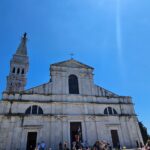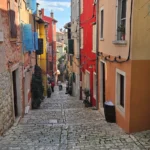
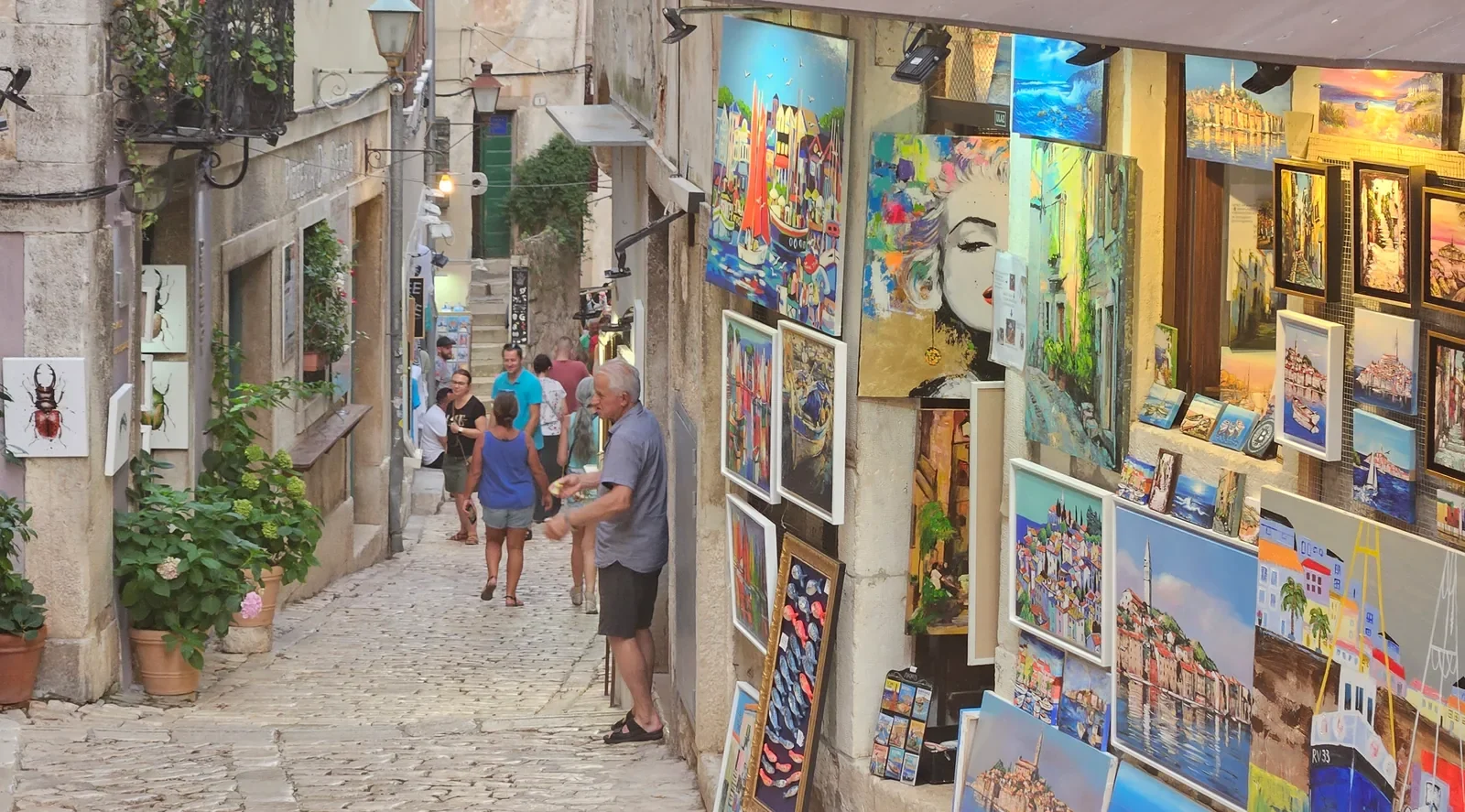
Grisia Street is one of the most distinctive routes through Rovinj Old Town: a steep stone lane that climbs from the historic centre toward the Church of St. Euphemia, lined with galleries, small studios, craft shops and colourful façades.
It is often described as Rovinj’s artists’ street, but the best reason to walk Grisia is not simply to shop for art. The street connects several layers of the town at once — Venetian-era urban fabric, Rovinj’s modern artistic identity, everyday Old Town life and one of the most direct uphill routes to the hilltop church.
If this is your first visit, approach Grisia from the main square after seeing Balbi’s Arch, then climb slowly rather than treating it as a shortcut. The details along the way are the point.
Grisia Street at a glance
| Where | Rovinj Old Town, climbing from the central historic area toward St. Euphemia |
|---|---|
| Best known for | Artists, galleries, studios and the annual Grisia open-air exhibition |
| Cost | Free to walk; individual galleries and artworks are privately priced |
| Time needed | 20–40 minutes for the street itself; longer if you browse galleries |
| Surface | Steep, polished stone with steps and uneven sections |
| Best combined with | Balbi’s Arch, St. Euphemia, Old Town lanes, viewpoints and museums |
Why Grisia is known as Rovinj’s artists’ street
Rovinj has had a strong visual-art tradition for decades, and Grisia became its most visible public expression. Galleries and studios gathered along the Old Town lanes, while the street itself became associated with artists showing work directly to visitors.
The annual Grisia exhibition began in 1967 and developed into one of Rovinj’s best-known cultural traditions. The City of Rovinj-Rovigno still lists Grisia among the town’s signature cultural events and describes the street as the route linking the main square with St. Euphemia.
That artistic identity is important, but Grisia is not a formal museum street with fixed opening hours. Some spaces operate as galleries, some as shops or working studios, and activity changes noticeably with the season and time of day.
What you will see while walking Grisia
The street itself is narrow, steep and visually dense. Stone façades, colourful shutters, doorways, old paving and small side passages create the setting, while art and craft displays add another layer during the busier part of the year.
Small galleries and artist studios
Expect a mix rather than one consistent style. You may find paintings, prints, photography, ceramics, jewellery and other handmade work. Some spaces are clearly commercial galleries; others feel closer to an artist’s workshop.
Do not assume every gallery is open all day or all year. Summer has the strongest concentration of open doors and street activity, while shoulder-season visits can be quieter and more atmospheric.
Old Town architecture
Even visitors with little interest in buying art should look beyond the displays. Grisia is a good place to notice how tightly Rovinj’s historic houses are packed onto the hill and how the lanes adapt to the slope.
The polished paving can look beautiful in photographs but becomes slippery when wet. Shoes with grip are more useful here than sandals with smooth soles.
Views up toward St. Euphemia
As you climb, the upper part of the Old Town gradually opens toward the Church of St. Euphemia. The route is not a broad ceremonial avenue; it twists through a lived-in historic neighbourhood, which is part of its appeal.
Continue to our guide to St. Euphemia if you plan to enter the church area or climb the bell tower when access is available.
The annual Grisia open-air exhibition
The single most important date for Grisia is its annual open-air exhibition. The tradition began in 1967 and, after a five-year interruption, was revived in 2025.
In 2026, the event took place on 23 August from morning until evening, with exhibition space extending along Grisia from Matteotti Square to the area around St. Euphemia. The 2026 edition brought together 142 participating artists from Croatia and neighbouring countries.
The detailed 2026 programme published through CultureNet confirms that the event included painting, drawing, graphics, photography, sculpture, installation, performance and video, rather than functioning simply as a tourist art market.
For future trips, do not assume that Grisia will fall on exactly the same August weekend every year. Check the current Rovinj cultural calendar once your travel dates are fixed.
Best time of day to visit Grisia Street
Early morning
Come early if your priority is architecture and photography. The street is usually calmer, the stone lanes are easier to frame without crowds, and the climb feels more comfortable in hot weather.
The trade-off is that some studios and shops may not yet be open.
Late morning to early evening
This is generally the better period if you want to browse galleries and see the street at its most active. In summer, however, midday can be hot and crowded, especially when groups are moving between the central square and St. Euphemia.
Evening
Evening is pleasant for atmosphere and a slower Old Town walk, but it is less reliable for serious gallery browsing because individual opening hours vary.
A practical way to walk Grisia
The easiest approach is to make the street part of a longer Old Town route rather than visiting it as an isolated attraction.
- Start near the central square. Take a moment at Balbi’s Arch and the surrounding historic entrance area.
- Enter the Old Town slowly. The lower streets are busy with shops, cafés and pedestrian traffic.
- Climb Grisia. Stop at galleries or studios that genuinely interest you rather than trying to enter every doorway.
- Look into the side lanes. Short detours reveal quieter façades, small passages and glimpses of the sea.
- Finish at St. Euphemia. The church plateau gives you space to rest after the climb and continue toward several good viewpoints.
For a complete route with more stops, use our self-guided Rovinj Old Town walking route.
Buying art and souvenirs on Grisia
If you find a piece you like, ask a few simple questions before buying: who made it, whether it is an original or reproduction, what material or technique was used, and how it can be packed safely for travel.
That matters particularly with paintings, framed works and ceramics. Travellers flying with hand luggage should think about dimensions before buying, while visitors driving can usually be more flexible.
Prices vary enormously depending on the artist, medium, size and whether the work is original, so a single “typical Grisia price” would be misleading. Compare only when the works are genuinely comparable.
If you are mainly looking for gifts rather than fine art, our Rovinj shopping guide explains local products and souvenirs in more detail.
Accessibility and the climb
Grisia is one of the steeper streets in Rovinj Old Town. The historic paving is uneven, there are steps, and the stone can be slippery after rain. It is therefore not a comfortable route for wheelchairs, many mobility aids or anyone who struggles with steep inclines.
A gentler Old Town approach may still involve slopes because the entire historic peninsula rises toward St. Euphemia. Visitors with mobility limitations should plan around the terrain rather than assuming there is a fully step-free route through the oldest streets.
Families with small children may find a compact stroller awkward on the rough surface. A carrier is often easier for the steepest Old Town sections.
Is Grisia Street free to visit?
Yes. Grisia is a public street, not a ticketed attraction, so there is no entrance fee and no gate. You can walk through at any time.
Individual galleries, studios and shops keep their own schedules, and special events can temporarily change how busy the street becomes. The annual Grisia exhibition itself is designed as a public open-air cultural event.
How Grisia fits into a first visit to Rovinj
Grisia works best as one piece of a larger Old Town visit. Allow roughly two to three hours for the historic centre if you want to see the main square, Balbi’s Arch, Grisia, St. Euphemia, side lanes and waterfront without rushing.
Our broader Rovinj Old Town guide helps put the street into context, while the Rovinj museums guide is useful if Grisia’s artistic side makes you want more cultural stops.
Local tips before you go
- Wear shoes with grip. The old stone becomes especially slick after rain.
- Do not rush the climb. The street is short enough that pausing at side lanes and doorways adds more than racing to the top.
- Visit in different light if you enjoy photography. Morning is calmer; later in the day brings more activity.
- Expect seasonality. Summer has the liveliest gallery scene; outside the main season, some spaces may be closed.
- Respect private doorways. Not every attractive entrance or courtyard is a public gallery.
- Check August event dates separately. Grisia is annual, but the exact date can change from year to year.
Is Grisia Street worth visiting?
Yes, especially if you are already exploring Rovinj Old Town. It requires no ticket, adds very little detour to the walk toward St. Euphemia and shows a side of Rovinj that is more closely tied to art and local cultural identity than to a single monument.
The best visit is simple: enter from the lower Old Town, give yourself time to browse, take the climb slowly and continue to the church rather than turning Grisia into a stand-alone checklist stop.
Last updated: September 2026